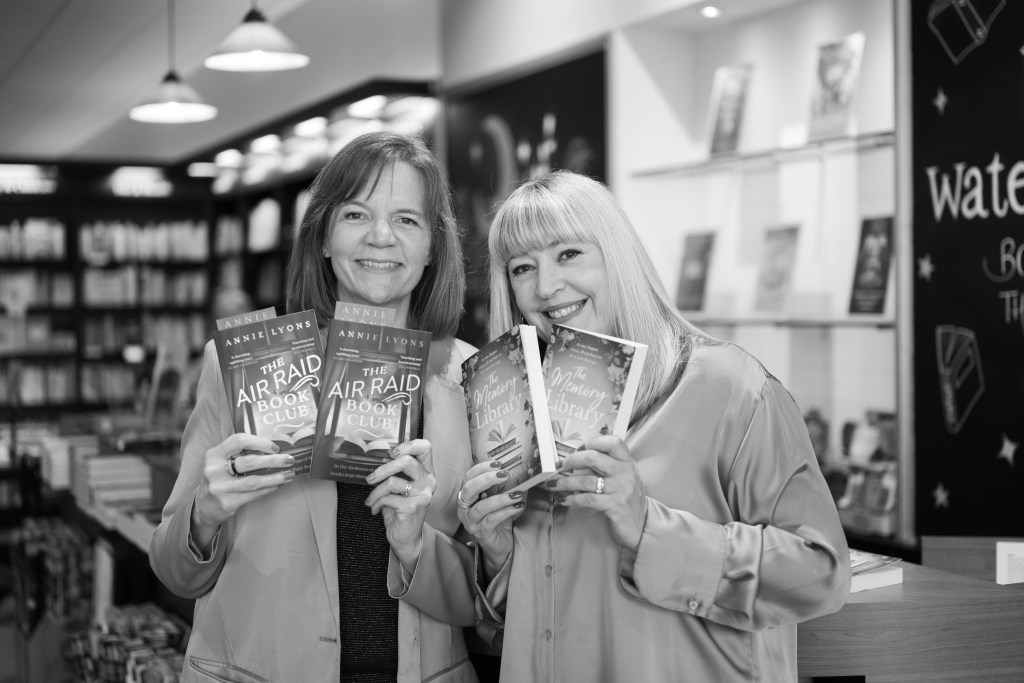
There are some books that you like, there are some books that you love and then there are the books you wish you could wander into, and this for me, is one of them. The Memory Library tells the story of an estranged mother and daughter, Sally and Ella, who are reunited after years spent apart after Sally has an incident which leaves her injured. With Ellas trip back to her hometown of Greenwich from her life in Australia, she is forced to pick up the fragments of her former life and face some uncertainties that have been formative in shaping Sally and Ella’s relationship. Themes of family, coming-of-age, community, the ever-changing dynamics of relationships and of course, books are at the heart of this wonderful novel. I loved every page of this book and am absolutely delighted to have had the opportunity to talk to Kate Storey herself all about her bookish world…
~
Firstly, I’d like to say that I absolutely loved The Memory Library. From its characters and
their development, to the themes that you weave throughout, the humour that’s scattered
among the pages as well as the setting of Greenwich; I enjoyed every moment of reading it.
What was your inspiration for writing The Memory Library?
That’s very kind, thank you! The idea sprang from a conversation with my editor. I was complaining that I’d just spent three pounds fifty on a birthday card with seven words in it. I joked that my books have eighty thousand words and often sell for less than that. We both agreed we’d rather receive a book than a card… and then the idea of a dedicated library built over birthdays came to life.
The Memory Library covers an array of topics as well as emotions and circumstances that
your characters experience. What part of Sally and Ella’s story for you, was the most important element to tell?
I always find myself writing about mothers and daughters and I suspect that might stem from being an adopted person, who also has a step-mother. That’s three mums! (although I’ve never met my birth mother). I also have two teenage daughters, and my relationship with them has changed significantly over the years and I expect it will continue to evolve. I found myself exploring the way our relationships develop over our lifetime as the book went on, without necessarily setting out to do so. I was asking myself when we begin to see our parents as flawed humans, just like us, instead of simply Mum and Dad, how difficult that realisation can be, and how that process could be interrupted by estrangement.
Your story is set in the South-East London town of Greenwich. It’s a place that’s very much part of my family’s life, having 3 generations of my family growing up, in and around this area, so it was a lot of fun to have places like the market, the Gypsy Moth and Up the Creek to name a few, be part of the backdrop to Sally and Ella’s story. What made you want to set their story there?
I’m originally from Yorkshire, but have lived in the South East London area for around thirty years, and have an enormous fondness for Greenwich. Lots of books about books and community are set in quaint, rural towns, but I wanted to show that community still exists in London. I wanted my characters to represent the diversity that thrives in the area and demonstrate that we can learn from people who are different to us, making an accepting and inclusive community which is richer and stronger because of the mix of individuals. Beautiful West Greenwich Library was also the ideal hub, partly because of the stunning building, but also because it was saved by the community who still support it.
I loved the community aspect of The Memory Library and the whole host of characters that make the book so full of life. From Hannah at the bookstall and Nathan from next door to creative and funny Verity and librarian Jakub (sometimes known as the fabulous Bridget Bard-Oh) as well as refugee Mina and strait-laced Pru. All of them bring a unique element to the story and make up the fabric of their wonderful community, one that inspires the reader to be more active in their own. How important have you found community, especially that of the book community, during your writing adventures so far?
I can’t begin to express my gratitude to the book community. It seems to me that most authors genuinely want their fellow writers to succeed. The accepted truth is that a rising tide lifts all ships. At the start of my publishing endeavours I met a group of writers who welcomed me into the fold, and that network has extended to include people who have become some of my closest friends. When I was unpublished and unrepresented, the published authors never made me feel any less, and were so generous with their time and advice. A group of us regularly go on retreats together, and they are food for the soul. The online book community is like no other. It’s kind, inclusive and endlessly supportive. It will always amaze me that booksellers and bloggers (like your lovely self) willingly give up so much of their time to shout about our books. I have developed virtual friendships with so many people over the last few years. I suspect I’ll meet many of them at Harrogate Crime Festival this summer, and I can’t wait! I’ve got so much more than a new career from writing; I’ve found my tribe.
In your book, Sally mentions that Nathan’s mum has fibromyalgia and that Nathan himself has ADHD. As a neurodivergent person and someone who has a loved one with fibromyalgia, it was amazing to see both of these conditions represented in literature as they aren’t often seen. How important do you think having positive representation in books is?
I think it’s crucial. I live in a neurodivergent household, and it’s very important to me that neurodivergence is represented accurately and positively. Nathan was a wonderful character to write, and I wanted his ADHD to be part of what made him the creative, thoughtful, bouncy and kind person he is. Not many people know these are typical ADHD traits! I write family dramas under the name Lisa Timoney, and my book His Secret Wife includes many neurodivergent characters. When my editor allowed me to make the ADHD diagnosis process a central part of the book, I was absolutely delighted. I’ve many messages from readers saying they learned a lot about neurodivergence from that book.
Was there a particular character that you had the most fun writing?
That’s a difficult question! I fell for all of them over the course of the book – even Pru in the
end. I think Jakub was probably the most fun because of his dancing hands and his fabulous
alter-ego. And who doesn’t love a librarian?
The Memory Library is very much a book about books and the power they have to change
and influence our lives. Do you have a favourite book-about-books?
I really love books about books! It’s hard to narrow it down, so I’ll choose a wonderful one I
read recently, and that’s The Air Raid Book Club by Annie Lyons. It’s beautifully written, heartwarming and truly shows the healing power of books.
You include many great classics and contemporary novels in The Memory Library (which has definitely made my TBR list a little longer!) mainly through Ella rediscovering her love of reading. Was it difficult to decide which books to incorporate into Sally and Ella’s story?
So, so hard! I’m an ex-English teacher and have always been an avid reader, so selecting what to include and what to leave out was exquisite agony. In the end, I had to choose books which conveyed a particular message and serve the dramatic purpose. Thankfully, another Kate Storey book about books is on the cards, so I’ll be able to include some I couldn’t last time.
If you could spend a day with one of your characters from The Memory Library who
would it be and how would you spend it?
I would sit on the sofa, next to Sally’s chair, and read. Then Sally and I would discuss our books, eat some cheese, have a nice cup of tea, then go back to reading in companionable silence. If Hadron came in, I hope he’d sit on my feet.
I know this is a tough question to ask any bookworm, but what 3 books would you most
like to be part of your own Memory Library?
Atonement by Ian McEwan, because my editor, Elisha, gave an inscribed copy to me when The Memory Library was published to start my own memory library. Pride and Prejudice by Jane Austen, because I studied it at school and it’s the first book that made me aware that you can be thoroughly entertained by a novel, as well as learn so much from it. The List of Suspicious Things by Jennie Godfrey. It’s a recent read which took me right back to being a child in Yorkshire in the 1970s. It’s the perfect mix of character-driven and page-turner and I’m recommending it to everyone I know.
The Memory Library is your fourth novel and your first written under your pen-name
Kate Storey. When did your love of writing begin?
I was that annoying, precocious child who kept a pen and paper by my bed in case I had an idea. I wrote awful, awful poems, all fancy words with no substance. I don’t even know why I’m admitting to that! Much as I loved writing, I didn’t even consider I might be published one day until I was in my forties. It’s given me a new lease of life!
What advice would you give budding authors starting out on their writing career?
Learn how to write a book! I was foolish enough to think that because I taught English, knew how to analyse a novel, and had always been a reader, I would be able to write a book. Annoyingly, there’s a lot more to it than that! If I’d known that structure is important because we generally understand stories in a certain way, I think I would have saved myself a couple of years. That’s not to say authors write to a formula, it’s more about hitting the right beats to make sure the reader has a satisfying reading experience. There are lots of books and courses (some free) online to help with this. My second piece of advice would be to find your writing tribe. They will be your sounding board, supporters and the people who truly understand this rollercoaster of a job.
And finally, Sally inscribes a book for Ella on her birthday each year, carefully selecting a book that encompasses something she wishes her daughter can learn from or take with her through life. If you could inscribe your book to your readers, what, like Sally hopes for Ella, is it that you hope your readers will take away from The Memory Library?
What a lovely question.
Dear Reader
This story is about healing. If there’s a relationship in need of repair, don’t put it off until it’s too late. Life is fleeting. Find joy, love and solace where you can, be it in family, friends, your community, or within the pages of a novel. #BeMoreSally – be open, kind and curious. Don’t judge, give more than you take, and keep learning. Finally, buy books for the people you love, and if all else fails, adopt a cat.
With love
Kate x
~
Thank you so much to Kate Storey for taking the time to answer my questions about Sally and Ella’s journey and all things bookish! And thank you reader, for reading my blog. I really hope you’ve enjoyed it and that you’ve been inspired to delve into the world of The Memory Library. If you would like to keep up to date with Kate Storey and her books you can find her on Instagram @lisatimoneywrites and by visiting her website www.lisatimoneywrites.com 🙂
~
 Views from a Bookshop